
A heartwarming short story about four friends, an old house and an evening filled with laughter, memories and unexpected discoveries. Sometimes the smallest moments become the ones we remember most.
Chapter 1 – An Evening of Minor Imperfections
Clara stood in the middle of the dining room, studying the table with a mixture of pride and growing desperation. For almost an hour, she had been trying to create that effortless sense of warmth and comfort that always looked so natural in interior design magazines. By now, she had folded the napkins three times, rearranged the candles twice, and decided that either the flowers in the centre of the table were too tall or their guests were too short.
A suspicious clatter came from the kitchen, followed by a muttered curse.
“Daniel? Is everything all right?”
“Absolutely!” came the reply. “I’m just testing the durability of our kitchen equipment.”
Clara smiled to herself. She knew that tone. It was exactly the same one Daniel had used a few weeks earlier when he announced that he was merely checking whether their new wall shelf was hanging straight. Three additional drill holes and a surprisingly extensive vocabulary later, they had discovered that the shelf wasn’t crooked at all. The floor was.
When she entered the kitchen, her husband was standing in front of the oven, holding a wooden spoon and sporting a flour stain on his shirt. He was examining the roasting chicken through the glass with the grave concentration of a surgeon performing a particularly complicated operation.
“How much longer does it need?” Clara asked.
“That depends on how patient our guests are.”
“Sophie and Thomas will be here in ten minutes.”
Daniel glanced at the clock and then back at the chicken.
“In that case, I’d say we should be very generous with the starters.”
Clara stepped beside him and inspected the oven. Parts of the chicken had already developed an extraordinarily confident shade of brown, while other areas seemed rather reluctant to participate.
“Maybe we should turn it again?”
“Clara, I’ve turned that bird more times today than we’ve turned the car trying to park in the old town. At some point, even a chicken deserves a little peace.”
She laughed and rested a hand against his back.
“I’m sure it’ll be wonderful. And if it isn’t, we’ll just order pizza.”
Daniel looked offended.
“We’ve spent three months renovating this house. I’ve installed an entire kitchen, replaced two water pipes and restored a built-in cabinet. And now I’m supposed to be defeated by a chicken?”
Before Clara could reply, the doorbell rang.
“Apparently,” she said with a smile, heading for the front door.
Sophie stood outside holding a bottle of red wine, her hair slightly tousled by the evening breeze and wearing the radiant smile Clara had known since their schooldays.
Beside her stood what appeared to be an unusually large green bush with legs.
“We brought you something!” Sophie announced cheerfully.
“I can see that,” Clara replied. “Did Thomas come along too?”
“Unfortunately,” came a muffled voice from somewhere behind the leaves.
Thomas carefully manoeuvred his way through the doorway, narrowly missing their new wall light with the enormous plant. Once inside, he set down the heavy pot and gave his wife a look of quiet resignation.
“Allow me to explain,” he began. “We wanted to buy you a small housewarming gift. Sophie apparently confused the word small with botanically impressive.”
“It’s a monstera,” Sophie explained, lovingly stroking one of its leaves. “It’ll bring life into the house.”
“And if it grows much bigger, Clara and Daniel will be able to charge admission.”
Clara laughed.
“It’s beautiful! Thank you both.”
“You hear that?” Sophie said triumphantly.
Thomas nodded.
“Of course. I’m sure Daniel is already looking forward to building an extension for it.”
At that moment, Daniel appeared from the kitchen, greeted their friends warmly and inspected the plant.
“Very nice. Where’s it going?”
“I’d suggest the guest room,” Thomas replied. “It’s about the right size.”
While the two men discussed whether the monstera might eventually require planning permission, Clara led her friend into the living room.
Sophie stopped just inside the doorway.
“Oh, Clara!”
For a moment, that was all she could manage.
The room glowed in the warm light of several small lamps. The old wooden floorboards shone with a honey-coloured warmth, soft curtains framed the windows, and a cream-coloured sofa stood opposite a low coffee table whose wooden surface Daniel had restored himself.
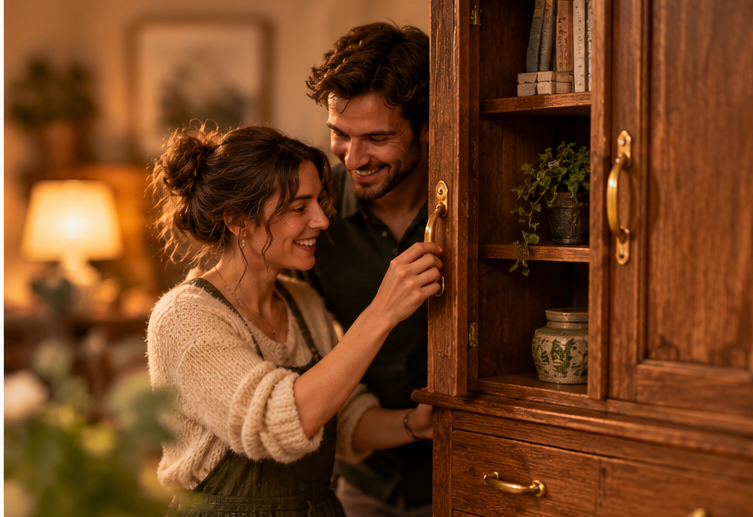
In one corner stood the old built-in cabinet they had originally planned to remove. Its rich, dark wood grain provided a beautiful contrast to the pale walls.
Sophie wandered slowly through the room, ran her fingers along the windowsill and admired the cabinet’s old brass handles.
“I can hardly believe this is the same house. Do you remember what it looked like when you bought it?”
Clara laughed.
“Of course. Daniel said we only needed to do a little painting.”
“That was my original plan,” Daniel protested, having followed them into the room with Thomas.
“Yes,” Clara replied. “Until the wiring, the plumbing and half the kitchen decided they wanted to take part in our renovation project.”
Thomas nodded sympathetically.
“Old houses are like ageing gentlemen. They can still look perfectly respectable from the outside, but once you take a closer look, there’s maintenance required everywhere.”
Sophie slowly looked her husband up and down.
“In that case, perhaps we should call a repairman next week.”
Clara burst out laughing, while Thomas gave his wife a long, wounded look.
“I’m clearly not appreciated enough in this household.”
“Oh, you are, darling,” Sophie replied, giving him a quick kiss on the cheek. “Just assessed very realistically.“

A little later, as they settled around the dining table, the smell of roast chicken, rosemary potatoes and freshly baked bread filled the room.
Clara had prepared a small starter, which had the considerable advantage of being ready before Daniel decided to engage in a personal battle with the main course.
Conversation flowed easily. They talked about work, a trip they’d taken together over the summer, and Sophie and Thomas’s neighbour, who had developed the habit of mowing his lawn at precisely seven o’clock every Saturday morning.
“Perhaps he simply enjoys gardening,” Clara suggested.
“Then he has a highly unusual idea of enjoyment,” Thomas replied. “Personally, I find sleeping a far more pleasant recreational activity.”
“You did tell him it bothered you,” Sophie reminded her husband.
“Of course. Very politely, too.”
Sophie raised an eyebrow.
“You asked him whether his lawn genuinely required emergency medical attention on a Saturday morning.”
“It was a perfectly reasonable question. The condition of the grass suggested no immediate danger to life.”
Daniel laughed so hard that he nearly knocked over his water glass.
Eventually, he brought in the chicken, which had by now acquired a remarkably even, if somewhat enthusiastic, shade of brown.
With visible pride, he placed the platter in the middle of the table and began serving everyone.
The first few minutes passed in encouraging silence.
Until Thomas took his second bite.
He chewed thoughtfully, reached for his wineglass and regarded Daniel with undisguised admiration.
“I really must compliment you.”
Daniel beamed.
“Thank you!”
“It’s remarkable how you’ve managed to make a single chicken both crispy and surprisingly resistant to chewing. That bird must have been in excellent physical condition.”
Sophie pressed her napkin against her mouth, while Clara desperately tried to keep a straight face.
Daniel put down his cutlery.
“It’s a free-range chicken.”
“That explains a lot,” Thomas replied. “Probably ran several miles every day.”
“Thomas!” Sophie protested between fits of laughter.
“What? I specifically said I was impressed.”
Clara helped herself to another potato and smiled at her husband.
“I think dinner is lovely.”
“Thank you, darling.”
“Especially the potatoes.”
Thomas immediately raised his glass.
“To the potatoes! May they be with us for many years to come.”
This time, all four laughed so hard that tears appeared in Clara’s eyes, and eventually even Daniel joined in.
It was the kind of laughter that only comes easily between people who have known each other for years. Nobody had to worry about a joke being misunderstood, and even the sharpest teasing was wrapped in an affection that needed no explanation.
When Sophie placed the last two potatoes on her husband’s plate, Thomas regarded the generous portion with theatrical alarm.
“Are you trying to fatten me up?”
“No, darling. I’m just trying to prevent you from raiding the fridge when we get home and claiming Daniel left you to starve.”
Thomas considered this, pushed the last piece of crusty bread towards her and said, “In that case, we’d better make this piece of evidence disappear as well.”
After dessert, which thankfully involved no further culinary surprises, the four friends settled comfortably in the living room.
Outside, a gentle rain had begun, tracing irregular patterns down the windowpanes.
Clara had just poured fresh coffee when Daniel casually mentioned that they had discovered an old cellar entrance while working on the outside wall.
“A second entrance?” Sophie asked immediately, intrigued.
“Yes, directly from the garden. It was bricked up at some point. We only noticed it when we removed the crumbling plaster. You could still see part of the old stone step beneath the brickwork.”
Thomas put down his coffee cup.
“Sounds perfectly sensible. The steps were probably damaged, or perhaps water kept flooding in during heavy rain.”
“Or,” Sophie began, smiling meaningfully, “it could have had a completely different purpose.”
Thomas sighed.
“Here we go.”
“Just imagine that someone once used that entrance to meet their secret love.”
Daniel frowned.
“In the cellar?”
“Why not? Perhaps their families disapproved of the relationship.”
“Of course,” Thomas replied. “And rather than meeting like normal people in the garden, they decided to conduct their romance between sacks of coal and crates of potatoes.”
Clara laughed, but Sophie refused to be discouraged.
“You have absolutely no imagination.”
“Oh, I have plenty of imagination. Mine simply includes a functioning sense of smell. I can roughly imagine what an old coal cellar must have smelled like.”
“Maybe it wasn’t a coal cellar,” Clara suggested. “The house used to be part of a much larger property. Perhaps they stored supplies there for several families.”
Thomas nodded approvingly.
“Finally, a sensible theory.”
“Or wine,” Daniel added. “Perhaps they used the garden entrance to bring heavy barrels straight into the cellar.”
Thomas sat up immediately.
“Hang on. An old wine cellar? And you didn’t reopen the entrance?”
“It was bricked up, Thomas.”
“Yes, I understood that part. But we could be talking about a wine cellar that’s been neglected for decades. I don’t think one should abandon such possibilities too hastily.”
Sophie folded her arms.
“Interesting. My secret romance was completely unrealistic, but the moment you hear the word wine, you’re ready to organise an archaeological excavation.”
“One has to have priorities.”
Clara burst out laughing again.
“We can still access the cellar normally from the kitchen, you know. And there was nothing down there except a few old shelves.”
Thomas shook his head in disappointment.
“Such a shame. I’d already started thinking about helping Daniel uncover the entrance.”
“You didn’t even help me carry the fridge when we moved in,” Daniel reminded him.
“A fridge isn’t a wine cellar.”
Sophie reached for her cup with a smile.
“Perhaps the previous owner’s wife had the entrance bricked up because her husband kept inviting people into his wine cellar.”
“That,” Thomas said, raising an appreciative finger, “is actually the first of your theories I consider plausible.”
“Oh, suddenly?”
“Of course. We must assume that sensible women were married to difficult men even in those days.”
Sophie stared at him for a moment before bursting into laughter.
“Thomas, that’s the first romantic thing you’ve said all evening.”
“No, my dear. That was purely historical research.”
Later, Daniel showed their friends the old built-in cabinet in the living room.
He had put a great deal of work into it, straightening the warped doors and carefully sanding the surface until the original wood grain became visible again.
“I actually wanted to get rid of it,” he explained, opening one of the heavy doors. “Clara had other ideas, naturally.”
“I simply couldn’t believe you wanted to throw away such a beautiful cabinet,” she replied.
“It wasn’t particularly beautiful at the time. It looked as though someone had spent fifty years trying to hold it together with furniture polish and wishful thinking.”
Thomas ran his hand across the dark wood.
“I have to admit, all that hard work has really paid off. The cabinet looks beautiful now.”
Clara smiled with satisfaction, while Sophie admired the old brass handles.
“Perhaps a carpenter once made it for his wife,” she suggested.
Thomas opened a drawer and examined the carefully crafted joints.
“Or for a customer who paid him properly.”
Sophie rolled her eyes.
“You really are a hopeless case.”
“I prefer to think of myself as a realist.”
Daniel showed Thomas a small section at the back where he had deliberately left the original wood untreated. The two men spent some time discussing old carpentry techniques, while Clara and Sophie wondered what the former owners might once have kept in the various compartments.
When Clara went to the kitchen for more coffee, she noticed that Thomas had become unusually quiet.
He was standing in front of the open cabinet, looking at one of the lower drawers.
“Everything all right?” she asked.
Thomas nodded, smiling almost shyly.
“Yes, of course. I was just thinking about my grandfather. He had a very similar cabinet in his workshop.”
Sophie stepped beside him.
“The one with all the screws?”
“That’s the one.”
He slowly pushed the drawer shut.
“When I was a little boy, I was allowed to open the bottom drawer. There were hundreds of screws and nuts in it, all different sizes, completely mixed together. My grandfather used to send me searching for whichever one he needed.”
“You must have spent ages looking,” Daniel said.
Thomas chuckled.
“Oh, I did. And just when I’d finally found the right screw, he’d often announce that he needed a different one after all.”
“Perhaps he simply wanted you to stay with him a little longer,” Sophie suggested.
Thomas didn’t answer immediately.
He looked at the drawer once more, then shrugged with a small smile.
“Or perhaps he genuinely had no idea which screw he needed. That would have been entirely like him.”
Sophie gently placed her hand on his arm, and Thomas gave her fingers a brief squeeze before turning back to Daniel.
“Tell me, how many hours did you actually spend working on this cabinet?”
“About forty-eight.”
Thomas let out a low whistle.
“Well, I hope you’ve insured it.”
“Thomas!” Sophie exclaimed.
“What? After forty-eight hours, I’d personally charge admission just to let people look at it.”
And soon they were laughing again.
Yet as Thomas followed the others back into the dining room, he glanced over his shoulder at the old cabinet once more.
Just for a moment.
Chapter 2 – What We Leave Behind
It was already past ten when Clara realised that the coffee machine had finished brewing its third pot of the evening. The rain had stopped, but a few remaining droplets still sparkled on the windowpanes in the light of the garden lamps. Sophie had curled up on the sofa with her legs tucked beneath her, Thomas had claimed the armchair beside her, and Daniel was attempting to squeeze a plate of homemade biscuits between the coffee cups and wineglasses.
Thomas regarded the biscuits with a degree of caution Daniel had come to recognise all too well.
“Did you make these too?”
“No, Clara did.”
“Excellent,” Thomas replied, immediately taking two. “Then I might survive the evening without permanent damage to my teeth after all.”
Daniel leaned back and folded his arms.
“You know, Thomas, next time I’ll just serve sandwiches. I can even have them inspected by a professional beforehand.”
“That would be very sensible. I could recommend someone who knows a thing or two about bread.”
Sophie rolled her eyes but couldn’t help laughing.
“You do realise that eventually nobody will invite you to dinner anymore?”
“Nonsense, darling. Clara and Daniel appreciate my honesty. Besides, after all these years, it would be terribly rude of them to replace me.”
Clara offered him the biscuit tin.
“Don’t worry, Thomas. We’re keeping you. After all, with this house we’ve already decided to learn to live with the existing defects.”
Daniel burst out laughing, while Thomas gave his hostess an appreciative look.
“Very good, Clara. I can see living with Daniel is finally paying off.”
The four laughed, and Clara noticed with some satisfaction that very little remained of her carefully planned table decorations. The napkins lay crumpled on the dining table, the flowers were crooked, and Thomas had clearly made himself at home in the armchair for the rest of the evening.
Oddly enough, she liked the room better now than she had a few hours earlier.
As she set down her coffee cup, she glanced at Daniel.
“Remember when we first viewed this house and you said it only needed a fresh coat of paint?”
Thomas sat up with interest.
“He said that?”
Daniel briefly closed his eyes.
“I have a feeling I know where this is going.”
“He even claimed we could move in before Christmas,” Clara continued. “Three weeks later, we had no kitchen, no working heating and a rather impressive collection of broken water pipes.”
“At least we had a roof over our heads,” Daniel defended himself.
“One that leaked when it rained.”
“But it was there. You can’t expect everything at once.”
Thomas raised his glass appreciatively.
“Finally, someone with a sensible attitude towards buying property. A roof that actually exists is already an excellent start.”
“I sincerely hope you never become an estate agent,” Sophie replied.
Daniel grinned and began describing how, during the renovation, they had spent several evenings eating dinner while sitting on upturned paint buckets because every piece of furniture was hidden beneath dust sheets.
Clara remembered one particular Sunday when Daniel had decided to prepare a proper meal despite the absence of a functioning kitchen.
“You insisted on cooking pasta that day, remember?” she asked.
“And there’s absolutely nothing wrong with that.”
“No, of course not. Although most people would usually use a saucepan.”
Sophie looked from one to the other with growing curiosity, while Daniel already suspected that the next few minutes would not be particularly kind to his reputation.
“We didn’t have a stove yet,” Clara explained, “so Daniel set up a camping burner. And because he couldn’t find a suitable pan, he put a metal bowl inside a large terracotta flowerpot to stop it wobbling.”
Thomas stared at his friend.
“You tried to cook pasta using a flowerpot?”
“It was a metal bowl,” Daniel emphasised.
“Oh, I see. My apologies. For a moment there, I thought you’d done something unusual.”
Sophie laughed so hard that she had to lean against Thomas’s shoulder.
“And did you actually eat the pasta?”
Clara shook her head.
“No. When the water still wasn’t boiling properly after twenty minutes, we ordered pizza.”
Thomas nodded with satisfaction.
“Sometimes a man simply has to recognise when a project exceeds his abilities.”
Daniel gave him a pointed look.
“Two years ago, you tried to fix your bathroom door with a butter knife.”
Sophie immediately sat upright.
“Oh, please tell that story!”
Thomas assumed an expression of perfect innocence.
“That was an entirely different situation.”
“Of course,” Daniel replied. “In my case, it was only pasta. In yours, you ended up having to call a carpenter.”
Clara burst out laughing, while Sophie gave her husband a triumphant look.
“Finally! Someone else is saying it!”
Thomas sighed and reached for another biscuit.
“I seem to be surrounded by a thoroughly disloyal bunch of people.”
When the conversation settled down again, Daniel showed their friends a photograph of the old garden bench they had discovered behind an overgrown rosebush while clearing the property.
The wood had been grey and weather-beaten, one leg was missing, and the seat was so rotten that even a particularly adventurous cat might have thought twice about sitting on it.
“I wanted to throw it away,” Daniel explained, “but Clara had other ideas, naturally.”
“Naturally,” Thomas echoed. “I’m beginning to see a pattern here. You want to throw things away, Clara rescues them, and then you have to repair them.”
“That’s not true at all,” Clara protested. “I restored almost the entire bench myself.”
Daniel nodded and showed them a second photograph.
The same bench now stood at the edge of the lawn, carefully sanded and decorated with two pale cushions. The wild rosebush had been trimmed back, and the restored bench looked as though it had always belonged in that very spot.
Sophie admired the picture.
“It looks absolutely beautiful!”
“Thank you,” Clara replied, clearly pleased. “I spent several weeks working on it. Daniel only had to help me with the missing leg.”
“Because my lovely wife was originally convinced she could simply glue it back on,” Daniel added.
“With special wood glue!”
“Of course. As long as nobody actually sat on it, that probably would have worked.”
Thomas regarded Clara with theatrical admiration.
“A garden bench you’re not allowed to sit on. Very stylish. If I ever start making furniture, I shall adopt that business model.”
Clara reached for a sofa cushion, but Thomas quickly raised his coffee cup in defence.
“Careful! I’m holding valuable porcelain.”
“It’s from IKEA,” Daniel replied.
“That makes it even more tragic. An irreplaceable collector’s item.”
Laughing, Clara put the cushion down again and described how she had discovered the wood’s original colour while sanding the bench. Beneath the weathered layers, a warm honey-coloured grain had emerged, and she had been determined to preserve it.
“I think sometimes you simply need to take a closer look before throwing something away,” she said.
Daniel studied his wife for a moment.
“She’s right, you know. Without Clara, we’d probably have replaced quite a few things that now give this house its character.”
Sophie smiled.
“That doesn’t surprise me. Clara could never bear to part with anything, even when we were younger.”
“That’s a terrible exaggeration!” Clara protested.
“Oh, really? Remember that ceramic frog you made at school?”
Clara immediately started laughing.
“It wasn’t that bad!”
“Clara, it had three legs, one crooked eye and a facial expression that suggested it had just discovered frogs are supposed to have four legs.”
Daniel looked at his wife with interest.
“I’ve never seen this frog.”
“That’s because it’s at my mother’s house.”
Thomas placed a hand over his heart.
“Thank goodness. For a moment I was afraid Clara might restore it and put it beside the fireplace.”
“Be careful what you say,” Clara replied. “I might just smuggle it into your living room.”
Sophie laughed.
“At least Thomas would finally have something in the house that looks like him before his morning coffee.”
This time Daniel almost spilled his coffee laughing.
Eventually, Sophie glanced at the clock and was surprised to discover that it was almost midnight.
“We really should get going. We have to be up early tomorrow.”
Thomas looked at her in disbelief.
“Four hours ago, you said we’d only stay for a little while.”
“That was the plan.”
“Quite. Back then I was still young and full of hope.”
While Sophie gathered her handbag, Clara accompanied her into the hallway and helped her into her coat. Daniel took the last glasses into the kitchen, and Thomas attempted to put on his jacket without knocking over the enormous monstera standing temporarily beside the coat rack.
“Ah yes, our little gift is still here.”
“It’ll have a lovely place by the window tomorrow,” Clara assured him.
“In that case, I’d reinforce the windowsill first,” Thomas advised. “I don’t want to be held responsible when your entire house disappears behind a houseplant one day.”
Clara gave her friend a warm hug, while Daniel and Thomas said goodbye with a friendly embrace of their own.
“Next time, I’ll bring the chicken,” Thomas announced.
“Excellent,” Daniel replied. “Then I can finally see how it’s supposed to be done.”
“I’d rather not take that risk.”
Sophie shook her head with a smile.
“You two will still be teasing each other twenty years from now.”
“I hope so,” Clara said.
It was a simple remark, almost casually spoken, and yet the others smiled for a moment before Sophie and Thomas stepped out into the cool night air.
Clara and Daniel waved until the car’s rear lights disappeared around the next bend.
The drive home was unusually quiet at first. The roads still glistened from the rain, and Sophie watched the houses passing by, most of their windows dark at this late hour.
“That really was a lovely evening,” she said eventually.
Thomas nodded.
“Apart from the chicken.”
“You’re impossible.”
“So I’ve been told. More than once this evening.”
Sophie smiled and returned her gaze to the window. After a while, she asked, “Do you know what that old cabinet reminded me of?”
“Your desire to redecorate our entire flat?”
“No. My grandmother’s dining table.”
Thomas glanced at her.
“The one that’s been sitting in our cellar for years?”
She nodded.
“When we were children, we used to hide underneath it. Grandma would pretend she couldn’t find us, even though our feet were sticking out.”
Sophie chuckled softly at the memory.
“And on Sundays, she’d always make that apple cake. Remember, the one with the thick crumble topping? We had to wait until everyone was sitting at the table before we were allowed to start.”
Thomas smiled.
“I remember. You once told me your grandmother always made the crumble extra thick because you loved it so much.”
Sophie nodded and fell silent for a moment.
“Funny, isn’t it? When she died, I desperately wanted to keep that table. And then we put it in the cellar because it didn’t match our furniture.”
Thomas thought for a moment.
“It is rather large.”
“I know.”
“And heavy.”
“I know that too.”
“And you did say you thought it was ugly.”
Sophie turned towards him.
“Thomas, are you trying to talk me out of this?”
He smiled.
“No. I’m simply wondering how I’m going to get that monster back up the cellar stairs.”
Sophie laughed.
“Maybe we could sand it down. Like Daniel did with the cabinet.”
“Ah, now I understand. Not only did we give away a monstera tonight, we’ve managed to acquire ourselves a renovation project.”
“Would that really be so terrible?”
Thomas was quiet for a moment as they stopped at a red light.
“No,” he said at last. “Actually, it wouldn’t.”
When the light turned green, he drove on and added with a sideways glance:
“But I insist on getting a new cordless drill.”
Sophie laughed so heartily that Thomas couldn’t help grinning himself.
Back at the house, everything had grown quiet.
Clara stood in the kitchen loading the last glasses into the dishwasher, while Daniel extinguished the candles and straightened the cushions on the sofa.
When he came to join her, she was leaning against the worktop, gazing into the dining room.
“What’s wrong?” he asked.
“Nothing. I was just thinking about how much effort I put into setting the table today.”
Daniel looked at the crumpled napkins and the slightly crooked vase of flowers.
“Not much left of that now.”
“No,” Clara replied with a smile. “But the evening turned out exactly as I’d hoped.”
Daniel stood beside her, and for a moment they both looked around the room that had seemed so unfamiliar to them only a few months earlier.
“You know,” Clara began thoughtfully, “I think tonight was the first time I’ve really felt that we’ve arrived here.”
Daniel looked surprised.
“Didn’t you feel that before?”
“In a way, yes. But until now, we’ve always been busy trying to finish everything. Tonight, for the first time, we simply lived in it.”
Daniel nodded slowly.
“That’s true. And Thomas only managed to find three things to make fun of.”
Clara laughed.
“At least seven.”
“I was being generous.”
She slipped an arm around his waist and rested her head against his shoulder.
“Do you think the people who lived here before us had evenings like this too?”
Daniel looked towards the old cabinet, the window shutters and the wooden floorboards that had carried so many footsteps over the years.
“I’m sure they did. Perhaps they even argued about the same things we do.”
“Such as?”
“Whether to keep an old cabinet. Or what colour to paint the shutters.”
Clara smiled.
“Or whether the flowers are too far to the left.”
Daniel turned towards her.
“I suspect people will still be arguing about that in this house a hundred years from now.”
She laughed and gave him a gentle nudge.
Then her gaze drifted towards the shelves Daniel had built himself and the old wooden table where they had just spent such a wonderful evening with their friends.
“I wonder whether someone will live here one day and try to work out why we arranged the house the way we did.”
Daniel considered this.
“Probably. And I imagine they’ll wonder which idiot installed the drawer beside the stove so crookedly.”
“The drawer isn’t crooked.”
“Yes, it is.”
“Then fix it.”
“I’m planning to.”
“You’ve been planning to for three weeks.”
He looked at her.
She looked back.
And then they both burst out laughing.
The following morning, warm sunlight streamed through the kitchen windows.
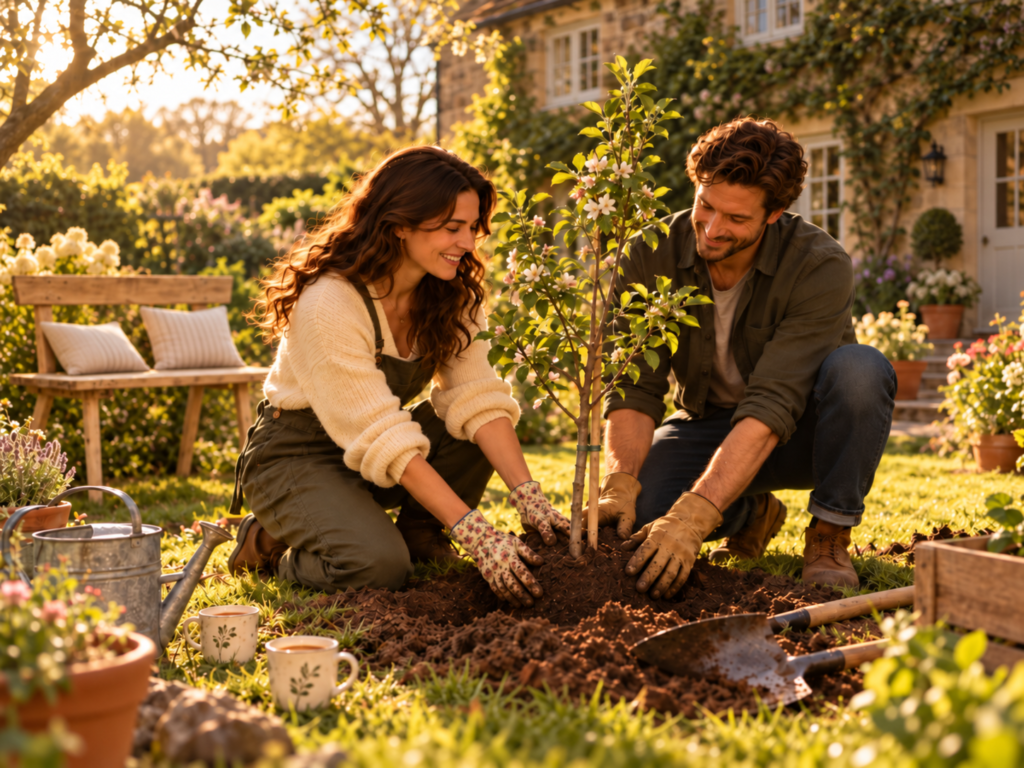
Clara had just made coffee when she spotted Daniel outside in the garden. He was standing beside the old wooden bench she had restored, studying a patch of lawn.
When she went outside carrying two mugs, she noticed a young apple tree lying beside him. Its roots were carefully wrapped in damp cloth, with a spade and a bucket of water nearby.
“What are you up to?” she asked in surprise.
Daniel took one of the mugs from her.
“I thought we could plant a tree here. This spot gets plenty of sunshine, and we’d have a lovely view of it from the bench.”
Clara examined the young tree, its branches still slender and delicate.
“Where did you get it?”
“I picked it up yesterday. I was actually planning to plant it next week, but today seemed like a good day.”
She smiled.
“An apple tree?”
“You did say once that you’d love to have one.”
Clara remembered it now. At some point during the renovation, she had casually mentioned how lovely it would be to have apples of their own growing in the garden one day.
The fact that Daniel had remembered touched her more than she expected.
“But why today?”
He glanced at the little tree and shrugged.
“I don’t know. Perhaps all that talk yesterday about the things other people have left behind got me thinking.”
Clara set her coffee mug on the bench and stepped closer.
“And now you want to leave something behind too?”
Daniel grinned.
“Actually, I’d just like to eat apple cake someday. But your explanation sounds much more impressive.”
She laughed, picked up the spade and began loosening the earth.
Together, they dug a hole large enough for the roots, carefully lowered the young tree into place and filled the soil back in. Daniel secured the slender trunk to a wooden stake while Clara fetched water and thoroughly soaked the earth around the roots.
When they had finished, they stepped back a few paces.
The little apple tree looked almost lost on the wide stretch of lawn.
“It looks a bit scrawny,” Daniel remarked.
“It’s still young.”
“Hopefully it’ll grow big enough for us to sit underneath it one day.”
Clara smiled and looked towards the old bench, where their two coffee mugs were still waiting.
“Perhaps one day we’ll sit here eating the first apple cake made with apples from our own tree.”
Daniel put an arm around her shoulders.
“As long as you’re the one who bakes it.”
“Why?”
“After last night’s dinner, I think we should establish some clear culinary responsibilities.”
Clara laughed and leaned against him.
They looked at the little tree once more before picking up their coffee mugs and heading back into the house.
Behind them, its slender branches stirred gently in the morning breeze.
It would be many years before the tree grew tall enough to cast its own shade. Perhaps one day, other people would sit on the old wooden bench, gather its apples and wonder who had planted it.
Enjoyed this story?
Discover more little worlds and the stories waiting inside them in our Miniature Stories collection.